

If you’ve been in the trucking game for more than a minute, you know the «Dispatch Dance.» It’s 6:00 AM, you have three phones ringing, four load boards open, and a driver in Ohio who just got empty and needs a reload before he runs out of hours. In the past, your success depended on your «gut feeling,» your relationships with brokers, and how fast you could type.
In 2026, the game has changed. We are no longer just «booking loads»; we are «optimizing capacity.»
Artificial Intelligence (AI) has moved from being a buzzword for big carriers like Knight-Swift or J.B. Hunt to being a survival tool for the 1-to-5 truck fleet. At FreightPulse360, we’ve seen a massive shift: carriers using AI-driven dispatching are reducing their deadhead (empty miles) by up to 35% and increasing their weekly revenue without adding a single extra truck.
Here is how AI is actually working on the ground in 2026 and how you can use it to outmaneuver the «old school» guys.
1. What is «AI-Driven Dispatching» in 2026?
Let’s clear the air: AI dispatching isn’t a robot taking your job. Think of it as a super-powered co-pilot.
Traditional dispatching is reactive—you wait for a truck to get empty, then you look for a load. AI Dispatching is predictive. By 2026, modern TMS (Transportation Management Systems) analyze your driver’s Hours of Service (HOS), real-time traffic, weather patterns, and historical lane rates to suggest a «bundle» of loads before the driver even arrives at the first receiver.
The «Deadhead Killer» Logic:
In 2026, AI doesn’t just find a load «near» your driver. It calculates the Total Trip Profitability.
- The Human Choice: «There’s a load 40 miles away paying $800. Take it.»
- The AI Choice: «Don’t take the $800 load. Deadhead 90 miles to the $1,100 load that puts you in a ‘Hot Zone’ for a high-paying return trip tomorrow. You’ll save 4 hours of dwell time and make $300 more by the end of the week.»
2. Top AI Dispatching Tools for Small Carriers in 2026
You don’t need a $100,000 IT budget to use this tech. Several platforms have leveled the playing field for small fleets.
A. Hemut: The «Mobile-First» Disruptor
Hemut has become the 2026 favorite for independent owner-operators. It’s an AI-driven platform designed specifically for small fleets.
- Why it’s great: It adapts to local road conditions and last-minute cancellations in real-time. It’s built for the person who is driving and dispatching at the same time.
B. Optimal Dynamics: The «Decision Engine»
Formerly only for mega-fleets, their 2026 «Small Biz» tier allows fleets with 3+ trucks to use high-level predictive modeling.
- Standout Feature: It simulates «What-If» scenarios. What if I take this load to Florida? The AI will show you the statistical likelihood of getting stuck there with a cheap $1.20/mile backhaul.
C. Smart Trucking TMS (by LoadConnect)
This tool integrates directly with your ELD (like Motive or Samsara). It «knows» exactly when your driver will be legal to drive again and starts bidding on loads 12 hours in advance.
3. Automated Broker Calling: The 2026 Game Changer
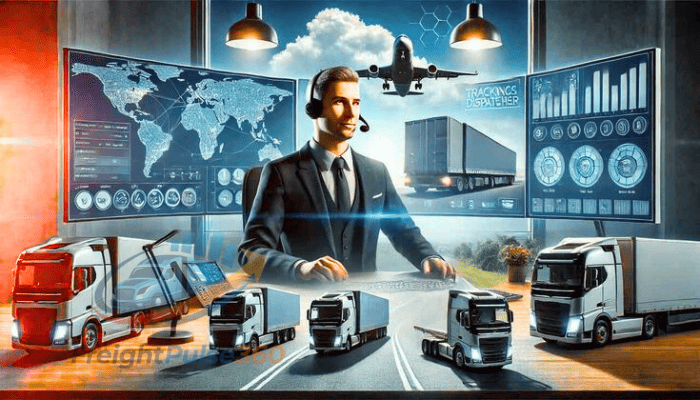
This is the most «sci-fi» part of 2026 trucking that is actually real. We are now seeing AI Voice Agents (like those from Numeo or Spot Finder Pro) that can actually place outbound calls to brokers.
How it works:
- The AI identifies a load on a board that meets your profit criteria ($3.00/mile, under 10k lbs).
- The AI calls the broker. It uses natural language to ask: «Is the load still available? What’s the total weight? Is it a dock-high or liftgate requirement?»
- If the criteria match, it notifies the human dispatcher: «I have a broker from TQL on the line for the Chicago load. Press 1 to take the call and finalize the rate.»
This allows one human dispatcher to do the work of three, focusing only on the final negotiation and relationship building.
4. Why AI is a «Must» for 2026 Profitability
The market in 2026 is tight. Rates aren’t skyrocketing, and fuel remains volatile. Efficiency is the only way to grow.
A. Cutting the «Hidden» Deadhead
Most people think deadhead is just the miles between a drop-off and a pick-up. But there is also «Time Deadhead»—the hours spent sitting at a truck stop searching for a load.
AI reduces this by predictive matching. By the time your driver is backing into the dock at 10:00 AM, the AI has already secured the 2:00 PM reload.
B. Routing for «Operationally Efficient» vs. «Fastest»
Google Maps tells you the fastest route. AI Dispatching tells you the most profitable route.
- It avoids tolls that would eat 15% of your profit.
- It routes you through states with cheaper fuel taxes (IFTA optimization).
- It avoids «HOS Traps»—areas with high traffic where your driver will burn through their 14-hour clock while sitting in a 5-mile jam.
5. Overcoming the «Black Box» Fear: Will AI Replace Dispatchers?
At FreightPulse360, we don’t believe AI replaces humans; it promotes them.
In 2026, the role of a dispatcher is evolving from a «data entry clerk» to a «Carrier Manager.» * The AI handles the 60% of grunt work: repetitive calls, status updates, and sorting through junk loads.
- The Human handles the 40% of high-value work: solving problems when a truck breaks down, negotiating with a broker who is trying to lowball you, and keeping the driver’s morale high.
6. Comparison: Traditional vs. AI-Driven Results (2026 Data)
| Metric | Traditional Dispatching | AI-Driven Dispatching |
| Deadhead % | 20% – 25% | 8% – 12% |
| Daily Dispatch Planning | 1-2 hours | 10 – 15 minutes |
| Truck Utilization | 70% | 90% |
| Monthly Revenue/Truck | $18,000 | $23,500 |
7. How to Start Using AI in Your Small Fleet Today
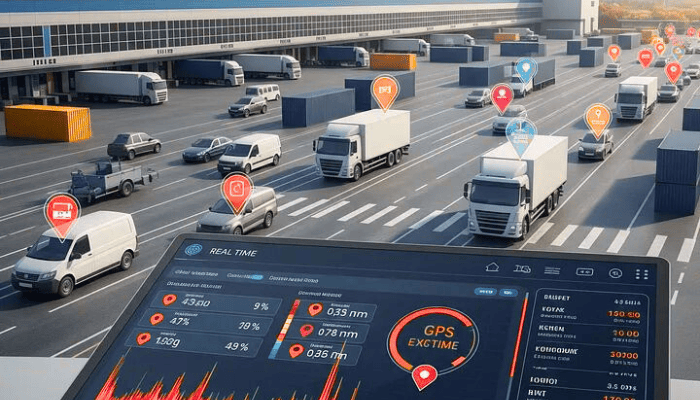
You don’t have to change your entire business model overnight. Here is the FreightPulse360 Implementation Plan:
- Integrate your ELD with your TMS: Most AI tools need your GPS and HOS data to work. Platforms like Samsara have an «App Marketplace» where you can plug in AI dispatching tools with one click.
- Set your «Profit Guardrails»: Tell the AI your minimums. Never book a load under $2.20/mile. Never take a load over 15,000 lbs.
- Use «Auto-Status Updates»: Start by letting AI handle the «Where is my truck?» calls from brokers. This alone will save you 2 hours of phone time a day.
8. The Ethics of AI in Trucking
As we move further into 2026, we have to talk about transparency. Brokers are starting to ask: «Am I talking to a human or an AI?» At FreightPulse360, we recommend being honest. Using AI for efficiency is a sign of a professional, modern carrier. Most brokers actually prefer it because AI provides more accurate ETAs and cleaner documentation than a distracted human.
9. Common Mistakes with AI Dispatching
- «Set it and Forget it»: AI is a tool, not a ghost-owner. You must still audit the loads it suggests. Sometimes AI might suggest a high-paying load that goes into a facility known for 8-hour detention times. The AI might not «know» that, but you do.
- Ignoring the Driver’s Preference: Your driver might hate going to New York City, even if the AI says it’s the most profitable move. If you force an AI-driven load on a driver who then quits, you’ve lost more money than the AI saved you.
10. Conclusion: The «Pulse» of the Future
The trucking industry is traditionally slow to change, but 2026 has been a wake-up call. The carriers that are winning aren’t the ones with the newest trucks; they are the ones with the smartest data.
Using AI-driven dispatching isn’t about being a «tech nerd.» It’s about ensuring that every mile your tires turn is putting the maximum amount of profit back into your pocket. If you can reduce your deadhead by even 10%, you’ve just given yourself a massive raise without working a single extra hour.
Recent Post
-
 Home
HomeHow to Pass a Level I DOT Inspection in 2026: The Ultimate Driver’s Checklist
The roadside inspection is the «final exam» for every commercial driver. In 2026, the Federal Motor Carrier Safety Administration (FMCSA) has integrated more biometric and -
 Trucking
The 2026 Transition to Electronic Medical Certificates for Truckers: What You Need to Know
The days of carrying a folded, sweat-stained piece of paper in your wallet to prove you are fit to drive are officially over. As of