

The box truck market in 2026 is no longer the easy-money landscape it was during the cargo van and box truck boom of the early 2020s. Shippers have grown more selective, freight rates fluctuate unpredictably, and fuel prices demand strict margin management. However, for owner-operators who treat this as a lean, data-driven logistics enterprise rather than just a driving job, starting a box truck business remains one of the most accessible paths to profitable fleet ownership.
A 26-foot box truck occupies a logistical sweet spot: large enough to handle multi-pallet freight, local distribution, and final-mile deliveries, but nimble enough to navigate urban centers without a Commercial Driver’s License (CDL) in many configurations.
This operational guide breaks down the actual realities of setting up shop, securing high-paying freight, maintaining compliance, and managing cash flow during your first year on the road.
1. Setting Up the Business Legal and Financial Foundation
Before looking at trucks or scrolling through load boards, you need a solid legal infrastructure. Cutting corners here can delay authority activation or leave you personally liable if an accident occurs on the interstate.
Entity Formation and Tax Structure
Most owner-operators start as a Limited Liability Company (LLC). This separates personal assets from business liabilities. Register your LLC in your home state, obtain an Employer Identification Number (EIN) from the IRS, and set up a dedicated business bank account.
Crucial Step: Never mix personal and business funds. When factoring companies or brokers run credit checks on your new entity, a clean, dedicated financial history is what builds immediate trust.
Understanding the CDL vs. Non-CDL Threshold
One of the primary appeals of starting a box truck business is the ability to operate without a CDL. However, you must understand the Gross Vehicle Weight Rating (GVWR) rules:
- Class 6 Vehicles (Non-CDL): A GVWR of 26,000 lbs or less does not legally require a CDL, provided you are not hauling hazardous materials or transporting passengers.
- Class 7 Vehicles (CDL Required): Anything at 26,001 lbs or more requires a CDL.
Many operators intentionally buy trucks rated at 25,999 lbs to bypass CDL requirements. This expands your hiring pool later if you grow into fleet management, but keep in mind that scaling back on GVWR reduces your actual cargo capacity. Overloading a non-CDL truck past its registered 26,000-lb limit can result in severe DOT fines at the scales and an immediate Out-of-Service order.
2. Navigating FMCSA Regulations, Authority, and Compliance
Operating commercially means stepping into a heavily regulated environment. Even if you stay under the 26,000 lbs threshold, interstate commerce triggers federal oversight.
Operating Authority: MC vs. DOT Numbers
If you plan to cross state lines with commercial freight, or haul cargo within a state that mandates federal tracking, you need active operating authority.
- USDOT Number: Monitors your safety metrics, inspections, and compliance history.
- MC (Motor Carrier) Number: Grants permission to engage in interstate commerce as a for-hire carrier.
The application through the FMCSA Unified Registration System costs $300. Once submitted, your authority enters a mandatory 21-day protest period. Use this window to secure your insurance policy and file your BOC-3 (Designation of Process Agents), which costs around $20–$50.
The New Entrant Safety Audit
Within your first 12 months of starting a box truck business, the FMCSA will conduct a New Entrant Safety Audit. They will check your Driver Qualification Files (even if you are the only driver), drug and alcohol testing records (if applicable), vehicle maintenance logs, and Hours of Service (HOS) compliance via Electronic Logging Devices (ELDs).
Internal Link Suggestion: «The Ultimate Guide to Passing Your First FMCSA New Entrant Safety Audit Without Stress»
3. Financial Realities: Upfront Costs and Operating Capital
A primary reason new box truck companies fail in the first six months is undercapitalization. They spend every dollar on the truck down payment, leaving nothing for fuel, insurance deductibles, or unexpected repairs.
The table below breaks down the realistic cost ranges for launching an interstate box truck operation in 2026.
| Expense Category | Estimated Upfront Cost | Recurring Monthly Cost | Operational Notes |
| Truck Down Payment / Lease | $5,000 – $15,000 | $1,200 – $2,500 | Varies heavily based on new vs. used and your credit score. |
| Commercial Insurance (Down/Premium) | $2,000 – $4,500 | $800 – $1,800 | New authorities face higher rates. Requires $1M Auto Liability / $100K Cargo. |
| FMCSA Authority & Post-Filings | $350 – $500 | $0 | Includes $300 filing fee, BOC-3, and UCR registration. |
| ELD, Toll Pass & Software Setup | $200 – $600 | $50 – $150 | Platforms like Motive or Samsara keep you HOS compliant. |
| Working Capital (Reserve Fund) | $10,000 – $15,000 | N/A | Essential for covering fuel and maintenance before invoices clear. |
| Total Estimated Initial Launch Outlay | $17,550 – $35,600 | $2,050 – $4,450 + Fuel | Always maintain at least 30 days of operating cash buffer. |
4. Selecting the Right Truck: Specs That Make or Break Profit
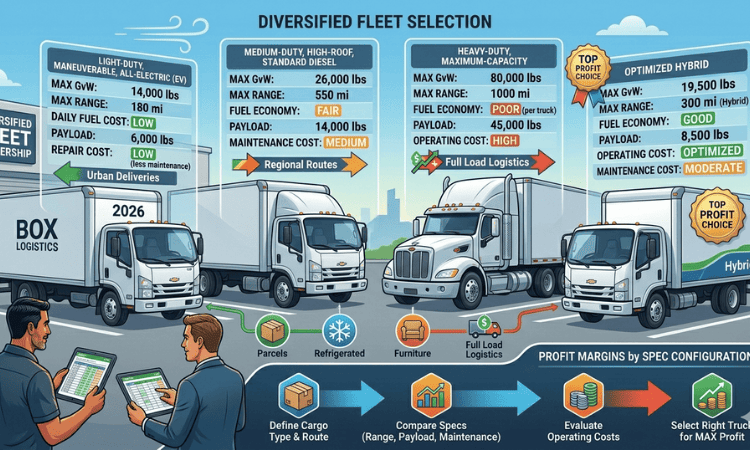
Choosing the wrong truck can limit the types of loads you accept, hurting your bottom line before you even turn the key.
Key Specifications to Prioritize
  ┌────────────────────────────────────────────────────────┐
  │                 IDEAL BOX TRUCK SPECS                  │
  ├────────────────────────────────────────────────────────┤
  │ • Dimensions: 26ft Length x 102in Width x 103in Height │
  │ • Liftgate: 3,000 lb+ Capacity (Tuckaway Preferred)     │
  │ • Floor: Hardwood with Row E-Tracks                    │
  │ • Rear Door: Roll-up for standard dock access          │
  └────────────────────────────────────────────────────────┘
- The 26-Foot Standard: A 26-foot box truck is the industry benchmark for general freight. Anything smaller limits your pallet capacity (12 standard 48″x40″ pallets unstacked), cutting you out of high-volume commercial contracts.
- The Liftgate Dilemma: A heavy-duty, tuck-away liftgate with at least a 3,000-lb capacity is non-negotiable for final-mile and residential deliveries where loading docks do not exist. Skipping a liftgate cuts your equipment weight, but it also excludes you from roughly 40% of the premium-rate box truck freight available on standard load boards.
- E-Tracks and Pallet Jacks: Your box should feature multiple rows of E-tracks to secure cargo using ratchet straps and load bars. Invest in a high-quality pallet jack immediately; relying on shippers to lend you equipment will stall your turn times on busy docks.
New vs. Used in 2026
Used truck prices have normalized compared to the historic highs of previous years, making a pre-owned International MV, Freightliner M2, or Isuzu F-Series an attractive option. However, if buying used, look for units with less than 150,000 miles and insist on a comprehensive preventative maintenance inspection that includes an engine oil analysis. A blown engine or failed emissions system can easily drain $10,000 to $20,000 from your account, killing a young business overnight.
5. Sourcing High-Paying Freight and Managing Cash Flow
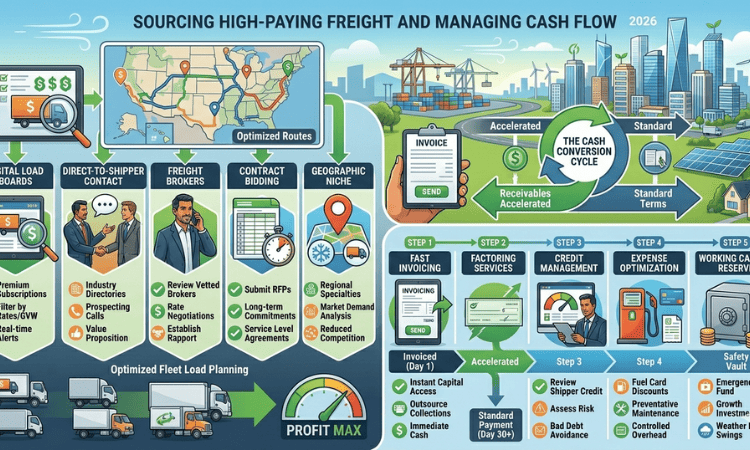
Finding profitable loads is the core challenge when starting a box truck business. Relying solely on public load boards can lead to a race to the bottom on rates. You need a diversified strategy.
Navigating Load Boards Strategically
Platforms like DAT One, Truckstop.com, and 123Loadboard are vital for filling backhauls (return trips) and building initial volume. However, because box trucks compete with hot shots and less-than-truckload (LTL) carriers, you must learn to negotiate.
Never accept the first offer posted by a broker. Calculate your operating cost per mile—including your truck payment, insurance, fuel consumption, and your own salary requirements—before calling. If your overhead is $1.40 per mile, accepting a $1.65 per mile load leaves you highly vulnerable to any unexpected operational hiccups.
The Power of Local Dedicated Contracts
To build long-term sustainability, move away from spot-market load boards within your first 90 days. Target local business-to-business contracts:
- Medical Equipment Supply Companies: High-margin, time-sensitive deliveries that require liftgates and inside delivery.
- Industrial and HVAC Distributors: Moving heavy equipment from regional warehouses to commercial job sites.
- Final-Mile eCommerce Providers: Partnering with regional hubs for local home delivery networks.
Internal Link Suggestion: «How to Pitch Local Businesses and Secure Dedicated Freight Contracts as an Independent Carrier»
Using Freight Factoring to Keep Rolling
Most direct shippers and commercial brokers operate on 30-, 60-, or even 90-day payment terms. Fuel docks and truck maintenance shops, however, require immediate payment.
To bridge this gap, many new operators utilize a freight factoring service. A factoring company purchases your open invoices for an upfront fee (typically between 1.5% and 4%), advancing you cash within 24 to 48 hours.
  Invoice Generated ($1,000) ──► Factoring Co. Reviews ──► 96-98% Advanced Cash (Within 24 Hours)
                                                                 │
                                                    Factoring Fee Deducted (2-4%)
When selecting a factoring partner, insist on a non-recourse agreement if your budget allows. This protects your business from being forced to buy back the invoice if the broker goes bankrupt or refuses to pay. Avoid long-term locking contracts that penalize you for growing out of the service later.
6. Fleet Management: Controlling Fuel and Maintenance Costs
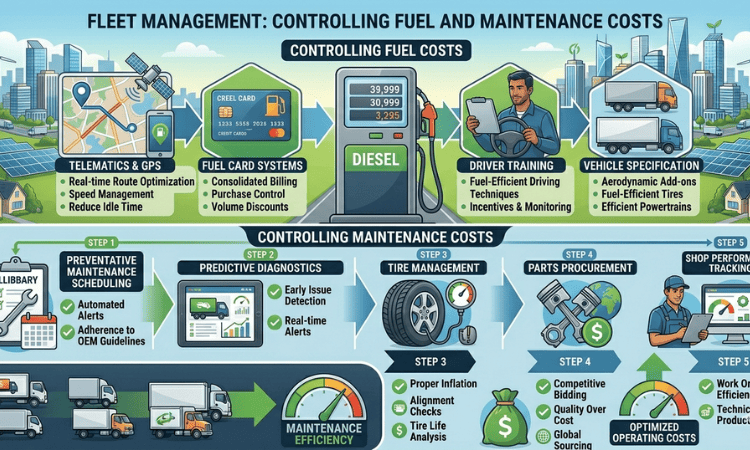
Revenue means nothing if your operating expenses swallow every dollar. Fuel and maintenance are your two largest variable expenses; ignoring them can quickly sink your business.
Fuel Card Optimization
A quality commercial fuel card provides structural discounts at major truck stops (such as Pilot Flying J, Loves, and TA), often saving you 10 to 40 cents per gallon off the cash price. Additionally, fuel cards streamline your data logging, offering clean accounting reports that clarify your exact cost per mile.
Preventative Maintenance (PM) Schedules
Do not wait for a check engine light to visit a technician. Box trucks operating in stop-and-go urban environments face heavy stress on brakes, transmissions, and cooling systems. Set up a strict preventative maintenance schedule:
- Every 10,000 Miles: Oil change, fuel filter replacements, and a thorough chassis grease job.
- Weekly Driver Inspections: Checking fluid levels, belt wear, tire tread depth, and monitoring for air brake or hydraulic system leaks.
7. Frequently Asked Questions (FAQs)
Can I start a box truck business with just one truck?
Yes, most successful independent fleets start with a single truck driven by the owner-operator. This allows you to learn the operational nuances, master local routes, and build cash reserves before scaling up, hiring drivers, or purchasing more assets.
Do box trucks have to stop at weigh stations?
In most U.S. states, yes. Any commercial vehicle over 10,000 lbs GVWR is legally required to pull into open weigh stations. Check your specific state DOT regulations, as rules can vary slightly depending on whether you are crossing state lines.
What is a realistic rate per mile for a 26ft box truck?
Rates fluctuate based on region, season, and fuel prices. National spot market rates for box trucks generally hover between $1.50 and $2.50 per mile. Dedicated local freight, specialized medical delivery, or expedited white-glove services can yield significantly higher returns.
How much does commercial truck insurance cost for a new authority?
For a brand-new MC authority with no previous commercial tracking history, expect annual premiums between $9,000 and $18,000 per truck. Rates depend heavily on your personal driving record, geographic location, and the specific commodities you intend to haul.
Do I need an ELD if I don’t have a CDL?
CDL status does not dictate ELD requirements. If you operate commercially outside a 150 air-mile radius from your home base and are required to keep a Record of Duty Status (RODS) for more than 8 days in any 30-day period, you must install an FMCSA-compliant Electronic Logging Device.
Making Your Business Sustainable
Starting a box truck business is a viable path to financial independence, but it demands meticulous operational execution. Avoid the trap of chasing low-rate broker freight on public boards indefinitely. Focus on keeping your upfront costs manageable, maintaining strict regulatory compliance, and protecting your cash flow with strategic factoring and fuel discount programs. By prioritizing direct client relationships and tracking every penny of your operating expenses, you can build a resilient, highly profitable transport company that stands the test of time.
1 comentario en «Ultimate Guide to Starting a Box Truck Business in 2026»