

If a freight carrier operates as the muscle of the logistics sector—buying assets, burning diesel, and rolling tires—a freight brokerage functions as the connective neural network.
A licensed freight broker does not own commercial semi-trucks or trailers. Instead, they operate as a specialized intermediary. Their primary asset is a highly optimized communication infrastructure that pairs corporate shippers who have cargo to move with asset-based trucking companies that possess empty capacity.
The strategic appeal of the brokerage model lies in its massive scalability and low asset overhead. Because you are not financing $150,000 physical road tractors or managing over-the-road equipment breakdowns, you can run a multi-million dollar logistics enterprise out of a standard commercial office space.
However, do not mistake a low physical asset footprint for an easy entry barrier. To build a legally compliant, highly liquid freight brokerage, you must navigate strict federal bonding laws, structure complex multi-party cash flows, and master the art of the spread.
The Economics of the Brokerage Spread
A freight brokerage generates revenue through a mechanism known as the spread—the financial margin between what a corporate manufacturer pays to move a load and what the broker pays a trucking company to execute the physical transportation.
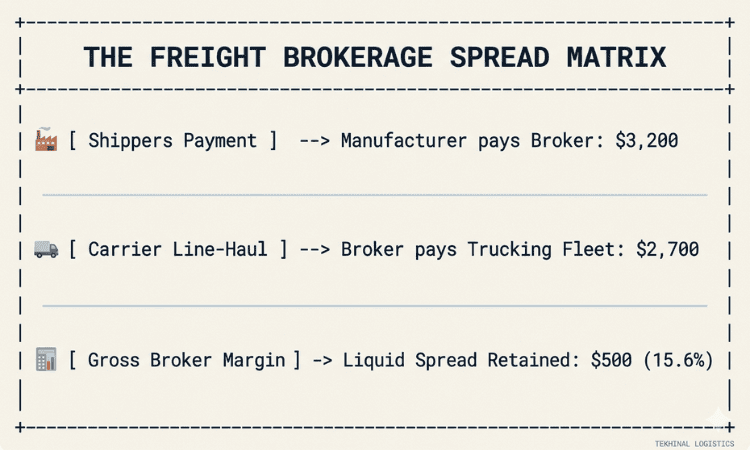
To maximize this spread, a broker must continuously monitor high-velocity spot market analytics via premium networks like DAT and Truckstop. Your profitability depends on your ability to accurately read regional capacity constraints.
If you quote a shipper a fixed rate on a lane during a seasonal harvest surge without factoring in the localized truck shortage, the cost to secure a carrier can easily exceed your shipper contract price, forcing your brokerage to take a financial loss on the move.
1. Navigating the Federal Regulatory Pipeline
Operating as an independent freight intermediary requires securing active brokerage authority from the Federal Motor Carrier Safety Administration (FMCSA). Attempting to broker a load without these active credentials carries severe federal penalties up to $10,000 per violation.
To secure your operating framework legally, you must execute the following structural steps:
- Filing Form OP-1: This is the primary application for a Broker of Property operating authority. The filing carries a non-negotiable $300 application fee, and requires establishing your legal corporate entity (typically an LLC or S-Corporation) beforehand.
- Designating a Process Agent (Form BOC-3): You must appoint a registered legal processing agent in every state you intend to conduct business operations. This compliance filing generally costs $25 to $50 through an approved federal provider.
- Securing Your Unified Carrier Registration (UCR): All brokers must pay an annual registration fee to support state-level highway safety and enforcement frameworks. The initial base tier is roughly $60.
2. The BMC-84 Financial Shield: The Real Capital Hurdle
The most critical regulatory hurdle for any new brokerage is satisfying the FMCSA’s mandatory $75,000 financial security requirement. This mandate is designed to ensure that if a brokerage goes bankrupt, hired carriers still receive payment for their road miles.
You can satisfy this requirement using one of two distinct financial structures:
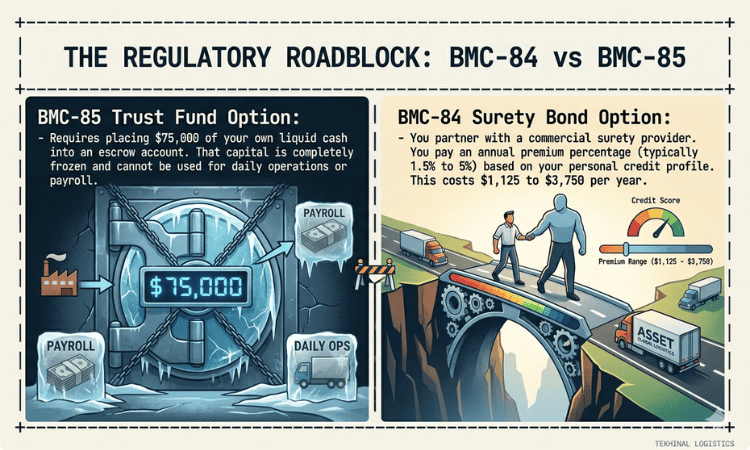
For startups looking to maximize their liquid runway, the BMC-84 Surety Bond is almost always the preferred strategy. It keeps your core startup cash fully liquid, allowing you to use your working capital to fund software infrastructure, marketing campaigns, and carrier advances.
3. Assembling the Digital Freight Logistics Stack
Because a modern brokerage is a pure data-management play, your operational efficiency depends entirely on your technology infrastructure. A high-yielding startup stack requires three core software applications:
Component 1: The Transportation Management System (TMS)
Your TMS is the central nervous system of your business. It allows you to build customer profiles, generate digital rate confirmations for carriers, store matching Bills of Lading, and track your total pipeline profitability. Premier platforms for startups include Alvves, McLeod, or Tailwind.
Component 2: Premium Load Board Integration
To source trucks rapidly, you must link your TMS pipeline straight to the industry’s primary digital load marketplaces: DAT and Truckstop. This allows you to post available shipments instantly to hundreds of thousands of independent truck fleets and review historical lane pricing data to protect your margins.
Component 3: Real-Time Freight Telematics Tracking
Modern corporate shippers demand total visibility over their inventory. To win high-value manufacturing accounts, your brokerage must integrate automated tracking tools like Project44 or MacroPoint. These systems link directly with a carrier’s electronic logging device (ELD) or smartphone GPS to provide your clients with real-time location updates every 15 minutes.
4. Cash Flow Mechanics and Carrier Liquidity
The underlying point of failure for expanding freight brokerages is cash flow timing misalignment.
When your brokerage wins a direct manufacturing account, that client will typically pay your invoices on a corporate Net-30 to Net-60 day delay. However, the independent carrier who physically hauls the load expects to be paid on a Net-15 timeline or immediately via a Quick Pay advance.
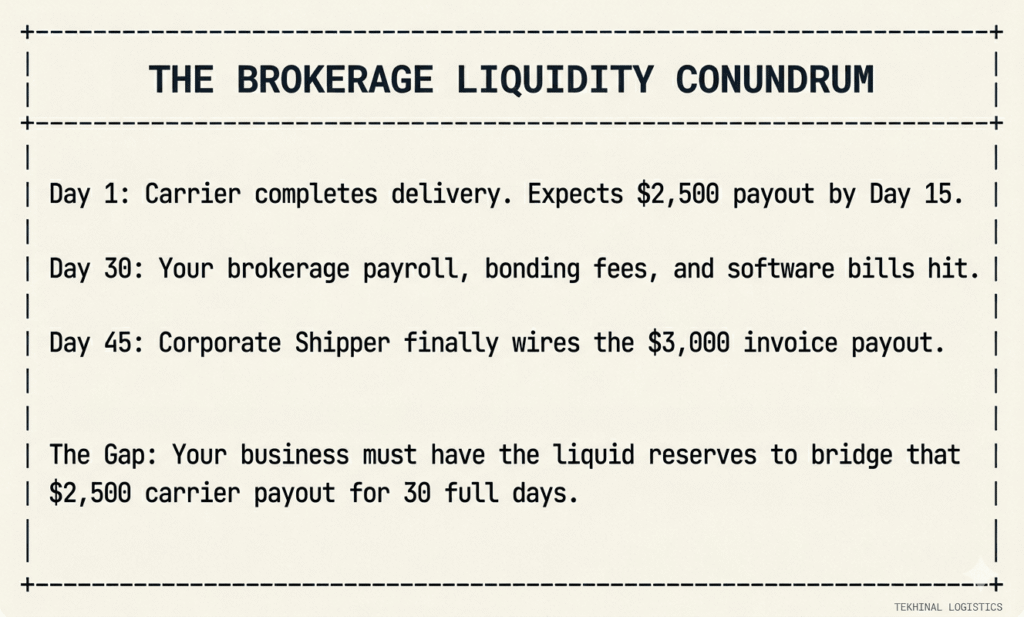
If your brokerage covers 20 loads a week with a similar capital lag, you will quickly find yourself needing tens of thousands of dollars in rolling credit to keep your carrier network happy. To solve this capital logjam, startup brokerages partner with specialized logistics funding groups or leverage commercial credit lines to guarantee uninterrupted carrier settlements.
Freight Brokerage Startup Capital Blueprint
| Operational Expense Category | Estimated Upfront Cost | Ongoing Monthly Cost | Strategic Mitigation Tactic |
| Federal Authority & Setup | $385 | $0 (Annual UCR varies) | File your business LLC before submitting the OP-1 application. |
| BMC-84 Surety Bond Premium | $1,125 – $3,750 | $0 (Paid annually) | Maintain a strong personal credit score to lower your premium percentage. |
| Logistics Software Stack | $500 – $1,500 | $200 – $600 / user | Start with lean, cloud-based TMS platforms before scaling to enterprise tiers. |
| Contingent Cargo Insurance | $2,500 – $5,000 | $200 – $500 | Secures a minimum of $100,000 in backup liability coverage to protect shippers. |
| Liquid Working Capital Buffer | $15,000 – $25,000 | Variable based on volume | Crucial for funding quick-pay carrier advances while waiting for shipper terms. |
Frequently Asked Questions
What is the difference between a Freight Broker and a Freight Forwarder?
A freight broker functions strictly as an independent matching agent who connects shippers and carriers without ever taking physical possession of the cargo. A freight forwarder takes direct physical custody of the freight, operates consolidation warehouses, assembles smaller shipments into larger units, and often issues their own house bills of lading for international multi-modal transit.
Do I need a Commercial Driver’s License (CDL) to open a brokerage?
No, because a freight brokerage is a purely administrative and operational sales company that does not own or operate physical commercial vehicles, there is zero requirement for you or your employees to possess a commercial driver’s license.
What is Contingent Cargo Insurance and why is it necessary?
While the physical carrier must carry their own primary cargo insurance (typically $100,000), a broker should carry Contingent Cargo Insurance. If a carrier steals a payload or their primary insurance provider denies a high-value cargo claim due to a technical loophole, your contingent policy steps in to pay the shipper, shielding your brokerage from catastrophic legal liability.
How do I win my first corporate shipping account as a new broker?
Winning accounts requires targeted industry prospecting. Instead of cold-calling massive consumer brands, focus on local, mid-market regional manufacturers who produce physical goods like specialized industrial plastics, construction materials, or regional agricultural packaging. Offer to take their hardest, most unreliable lanes first to prove your operational execution.
Scaling Your Intermediary Network
Building a successful freight brokerage requires a rare blend of sales grit and disciplined financial risk management. You are building an asset-light enterprise that trades entirely on operational integrity, clear communication protocols, and speed of execution.
By executing your compliance filings cleanly, securing a protective BMC-84 bond structure, and deploying an automated software stack that gives shippers total visibility over their inventory, you turn a highly competitive market into a predictable corporate engine. Manage your cash flow pipeline tightly, treat your carrier networks with respect, and build your logistics enterprise on a solid operational foundation.
1 comentario en «The Blueprint of a Freight Brokerage Startup»