
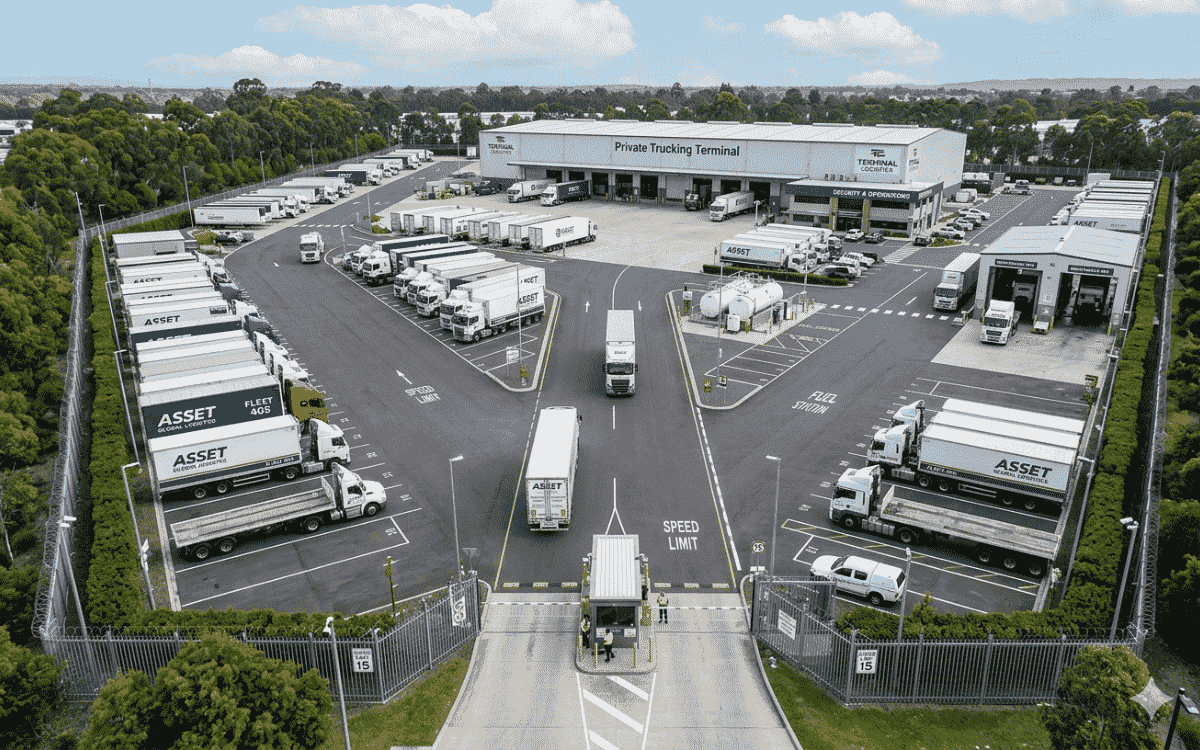
As your fleet scales past five assets, renting random commercial parking spaces or letting drivers park 80,000-pound combinations at residential properties becomes a major liability. Local zoning ordinances, security risks, and the logistical friction of decentralized maintenance will eventually force you to build or lease a dedicated commercial trucking terminal.
A functional fleet terminal is not just a paved parking lot surrounded by a chain-link fence. It is a highly specialized piece of industrial real estate designed to optimize asset velocity, ensure compliance with federal security mandates, and protect millions of dollars in rolling equipment from theft and operational damage.
1. Zoning, Site Selection, and Environmental Feasibility
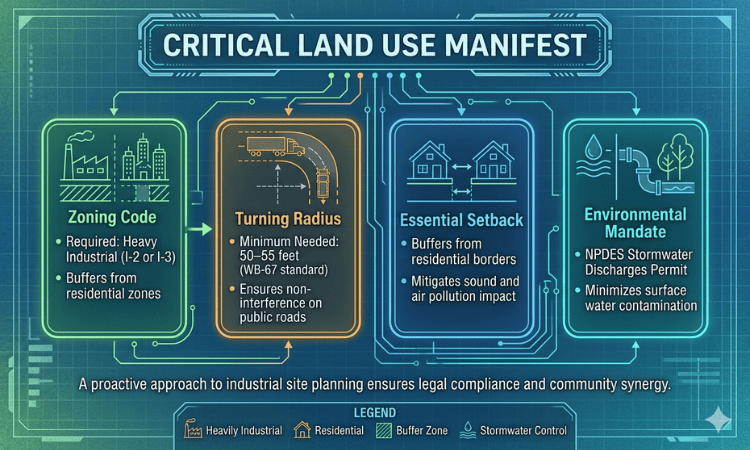
You cannot simply purchase a parcel of land next to a highway and park semi-trucks on it. Commercial transportation facilities face intense scrutiny from local planning commissions and environmental regulatory agencies.
Environmental Engineering & Runoff Management
Semi-trucks leak trace amounts of diesel, engine oil, and hydraulic fluid during routine operations. Under the Clean Water Act, your terminal must feature structured containment infrastructure.
Before laying pavement, you must install an oil-water separator system integrated into your grading and drainage network. This system captures surface runoff from the parking and maintenance bays, filtering out petroleum products before the water flows into municipal storm drains. Failing to secure a National Pollutant Discharge Elimination System (NPDES) permit before operating can result in federal EPA fines exceeding $10,000 per day.
2. Pavement Engineering and Layout Geometry
Standard asphalt or thin concrete slabs will quickly fail under the continuous weight of loaded commercial rigs. A single fully loaded combination vehicle exerts up to 80,000 pounds of gross force, concentrating extreme stress across small tire contact patches.
The Pavement Specification Standard
For areas featuring heavy traffic or trailer dropping zones, you must pour 8 to 10 inches of fiber-reinforced Portland cement concrete over a compacted 6-inch aggregate subbase. If you choose asphalt for general driving lanes to save on initial construction capital, it must feature a minimum thickness of 4 to 6 inches of heavy-duty commercial grade hot-mix asphalt (HMA).
Geometric Parking Configuration
To maximize space utilization and minimize backing accidents—the primary source of terminal insurance claims—your layout geometry should utilize a 60-degree or 45-degree angled parking configuration rather than a traditional 90-degree grid.
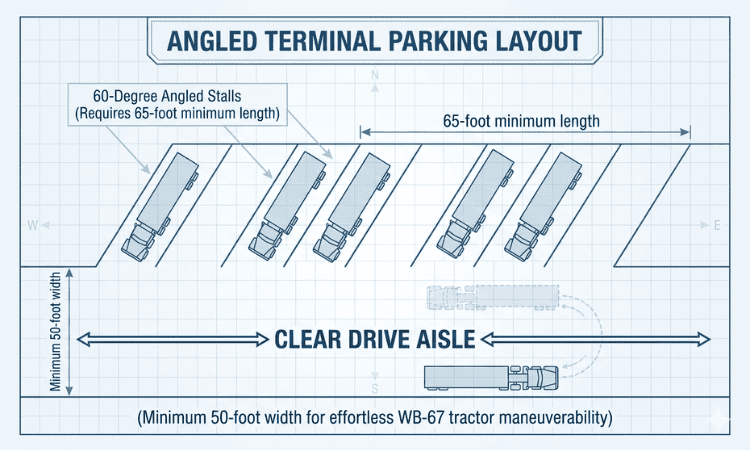
- Stall Dimensions: Each commercial tractor-trailer parking stall must measure a minimum of 12 feet wide by 65 to 70 feet long.
- The Landing Pad Requirement: If your terminal will host unattached trailers, you must embed a continuous 10-foot wide concrete landing strip beneath the area where the trailer landing gear rests. If you drop a heavy trailer’s steel dolly legs directly onto hot asphalt during summer heat, they will sink straight through the surface, causing major structural damage to both the pavement and the trailer.
3. High-Security Infrastructure & Asset Protection
A trucking terminal houses highly visible targets for cargo theft rings and equipment stripping operations. Securing your perimeter requires a multi-layered security protocol that reduces insurance risk profiles and satisfies the Customs-Trade Partnership Against Terrorism (C-TPAT) framework if you haul international cargo.
Layer 1: Perimeter Hardening
Encircle the entire facility with an 8-foot galvanized chain-link fence topped with three strands of commercial barbed wire or an integrated anti-climb mesh. The base of the fencing must be anchored securely or embedded into a concrete curb to prevent intruders from lifting the fabric.
Layer 2: Access Control Architecture
Eliminate physical padlocks. Implement a heavy-duty, commercial cantilever slide gate fitted with an access control system. Drivers should access the terminal using unique, trackable PIN codes, RFID cab tags, or smartphone credentials. This system generates a permanent digital access log that cross-references driver schedules with gate entries.
Layer 3: High-Lumen Illumination & Surveillance Optics
- Lighting Density: To eliminate blind spots where thieves operate, install perimeter and pole-mounted LED lighting arrays providing a minimum intensity of 2.0 foot-candles across the entire yard surface.
- Camera Placement: Deploy high-definition 4K surveillance cameras utilizing advanced internet protocol (IP) networks. Cameras should focus directly on the ingress/egress gates (with automated License Plate Recognition technology enabled), trailer locking zones, and the fuel terminal.
4. Integrating the Telematics and Compliance Hub
Your physical terminal must interface directly with your digital fleet operations. With strict federal regulations standardizing digital compliance trails, your yard infrastructure can serve as an automated checkpoint.
The Timestamp Compliance Challenge: FMCSA safety enforcement heavily scrutinizes the synchronization between ELD logs and Driver Vehicle Inspection Reports (DVIRs). If an automated gate log shows a truck exited the facility exactly two minutes after a driver logged «On Duty,» a DOT audit will flag the carrier for falsification—it is physically impossible to complete a legally compliant pre-trip vehicle inspection in that timeframe.
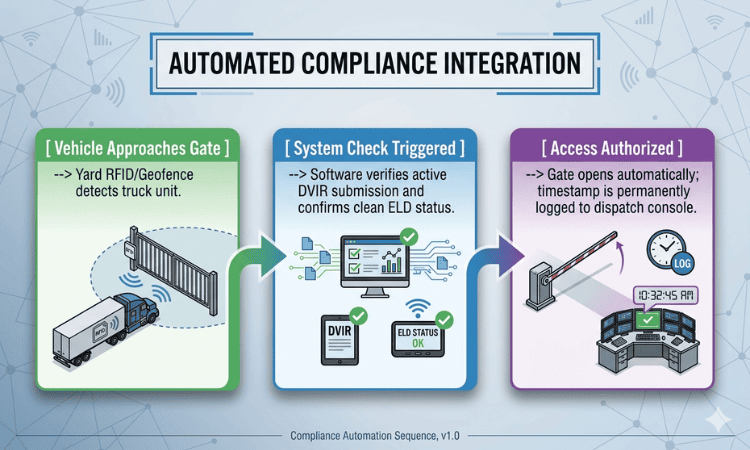
Integrating geofencing networks around your terminal boundaries allows your fleet management software to automatically verify that drivers are conducting their mandatory 15-minute walk-around safety checks inside the yard before the front gate opens, protecting your operating authority from devastating regulatory safety downgrades.
Terminal Development Capital Budgeting
| Infrastructure Asset | Estimated Setup Cost (Per Acre) | Primary Operational Objective |
| Site Grading & Heavy Concrete Slabs | $85,000 – $140,000 | Prevents pavement collapse under continuous 80,000-lb gross weights. |
| Oil-Water Separator & Drainage | $25,000 – $45,000 | Guarantees compliance with EPA clean water runoff regulations. |
| Perimeter Fencing & Cantilever Gate | $18,000 – $32,000 | Hardens the facility against sophisticated cargo theft threats. |
| AI Surveillance & Access Controls | $12,000 – $22,000 | Creates an immutable digital record of all terminal entries and exits. |
| LED High-Lumen Pole Lighting | $15,000 – $28,000 | Eliminates shadows to deter intruders and protect drivers during night runs. |
Frequently Asked Questions
How many trucks can I safely park on a single acre of land?
Accounting for standard 60-degree angled stalls, essential 50-foot clear driving aisles, perimeter safety setbacks, and storm water drainage infrastructure, you can comfortably configure between 20 and 26 fully combined tractor-trailer assets per acre. Trying to pack more trucks onto the plot drastically spikes your risk of low-speed backing accidents.
What is the advantage of adding a private diesel fueling island to my terminal?
Installing an on-site commercial fuel tank (typically 10,000 to 20,000 gallons) allows you to purchase diesel bulk-wholesale, frequently saving your fleet $0.20 to $0.40 per gallon compared to retail truck stop prices. Additionally, it ensures your drivers hit the road with full tanks, eliminating unbilled staging time at public pumps during the start of their hours-of-service clocks.
Do I need a building structure on-site to qualify for terminal insurance?
No, a physical office building is not a mandatory requirement to secure commercial fleet facility insurance. However, insurance underwriting groups will demand a fully secured perimeter, active automated gates, and comprehensive camera surveillance coverage before they will issue an active policy protecting unhooked cargo trailers left unattended on the property.
Can I operate a commercial maintenance bay inside an unheated fabric structure?
While basic pre-trip visual checks can occur anywhere, executing professional preventative maintenance (such as oil changes, brake drum replacements, or air-line repairs) requires an enclosed, structurally engineered shop space. The structure must feature reinforced concrete floors, industrial ventilation fans to clear diesel exhaust fumes, and proper hazardous material storage lockers for used fluids to maintain compliance with OSHA safety standards.
Securing Your Operational Core
Constructing a private fleet terminal represents a significant leap forward in your maturity as a commercial motor carrier. It transitions your company away from relying on volatile public truck stops and positions your operation as a self-sustaining logistics enterprise. By engineering your pavement to withstand heavy axle stress, building layered security perimeters to protect client cargo, and linking your gate infrastructure to your digital compliance suite, you build a physical foundation designed to sustain and protect your fleet assets for decades to come. Protect your equipment, control your facility footprint, and run your logistics operation with total structural authority.
1 comentario en «Building a Private Trucking Terminal: Property, Layout, and Asset Protection»