
As a logistics enterprise scales into a mid-size or large-market carrier, operational profitability is no longer won solely by booking high-paying loads or negotiating bulk fuel discounts. The modern corporate logistics arena is intensely data-driven. A fleet’s long-term financial survival depends on its ability to leverage real-time telematics data to manage its corporate safety profile and protect its margins from severe risk exposure.
In the current transportation landscape, plaintiff attorneys routinely target commercial fleets using aggressive legal strategies that exploit minor regulatory administrative gaps. If your fleet lacks a unified, proactive data ecosystem, a single over-the-road safety incident can expose your corporate entity to devastating financial liabilities.
1. The Reality of Modern Legal Risk: Combating Nuclear Verdicts
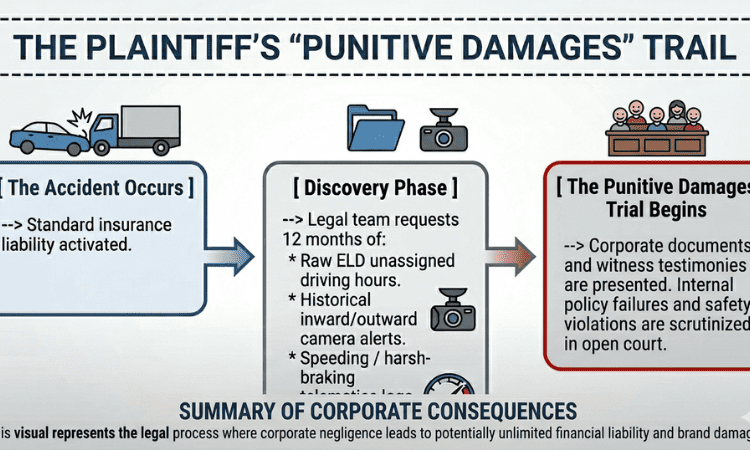
The logistics sector faces an era of nuclear verdicts—legal judgments in trucking accident cases that routinely exceed $10 million. Plaintiff counsels achieve these massive payouts not just by proving a driver caused an accident, but by demonstrating a corporate pattern of negligent entrustment and systemic compliance failure.
To insulate your assets, fleet managers must transition from simple passive data recording to an active, legally bulletproof Predictive Safety Framework.
2. Transforming Telematics Into a Legal Shield
Modern Electronic Logging Devices (ELDs) and Advanced Driver Assistance Systems (ADAS) track hundreds of operational data points per second. Simply collecting this data is not enough; your compliance team must establish a closed-loop processing system.
The Automated Driver Risk-Scoring Engine
A scaled fleet should deploy a centralized telematics dashboard that aggregates real-time over-the-road behavioral exceptions:
- Severe G-Force Exceptions: Sudden deceleration (harsh braking) or aggressive cornering events.
- Absolute vs. Relative Speed Violations: Tracking when a truck exceeds the absolute speed limiter or travels faster than localized variable speed limits during adverse weather conditions.
- AI-Powered Distracted Driving Flags: Inward-facing camera optics detecting mobile phone use, seatbelt non-compliance, or persistent microsleep/fatigue indicators.
The Enforcement Gap Rule: Under strict federal safety enforcement guidelines, if an artificial intelligence camera system flags a driver for lane departure or distraction, and your internal safety officer does not log an explicit Corrective Action Plan (CAP) or formal driver coaching workflow within 72 hours, the data shifts from a safety asset to a massive internal liability during an administrative audit.
3. Designing a Legally Resilient Coaching Workflow
To build an unassailable corporate defense shield, your safety infrastructure must treat telematics alerts as explicit triggers for mandatory organizational intervention.
1.Automated Event Capture and Exception Triaging:Phase 1.
The vehicle’s ADAS or smart camera detects a critical safety breach (e.g., tailgating within a 1.5-second buffer zone). The 10-second video snippet and localized telemetry are uploaded immediately via cellular networks to the fleet management console.
2.Structured Risk Categorization and Alert Assignment:Phase 2.
The platform’s safety engine ranks the event based on risk severity. High-priority exceptions automatically lock an uneditable compliance ticket onto the safety director’s daily work queue, preventing manual deletion or modification of the record.
3.Execution of Documented Driver Coaching Remediation:Phase 3.
The safety officer reviews the video footage alongside the driver, executing a standardized coaching curriculum. Both parties sign a digital Performance Corrective Form detailing the root cause, defensive driving alternatives, and a scheduled follow-up review window.
4. Operational Optimization: Predictive Maintenance Mining
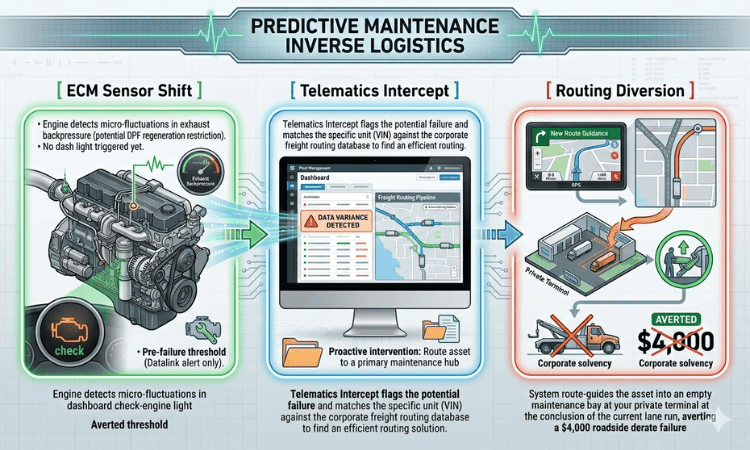
Advanced fleet analytics protect more than just your legal safety profile; they maximize your asset velocity by identifying underlying mechanical failures hours before an in-cab check-engine light activates.
By integrating your telematics platform directly into your enterprise asset management system, you can pull real-time Engine Control Module (ECM) diagnostic trouble codes (DTCs) across your entire operating footprint.
Enterprise Fleet Risk Management Matrix
| Analytical Data Feed | Real-Time Risk Exposure | Long-Term Strategic Value | Infrastructure Tooling Requirement |
| Active Hours of Service (HOS) Auditing | Immediate roadside out-of-service violations; severe federal CSA score penalties. | Protects operating authority status; stabilizes corporate commercial insurance renewals. | API integration linking dispatch software directly with the active ELD suite. |
| AI Drive-Cam Telematics | Direct exposure to catastrophic nuclear verdicts via documented uncoached behaviors. | Liquidated liability protection; provides definitive exoneration evidence in accident claims. | Dual-facing 4K dash cams with built-in machine-learning edge analytics. |
| Over-the-Road Diagnostic Fault Mining | Sudden, unpredictable road breakdowns; compounding emergency towing overhead. | Reduces overall maintenance spend by shifting repairs from roadside to terminal bays. | Automated ECM network scraping software with priority filtering modules. |
| Fuel Efficiency / Idle Analytics | Accelerated margin erosion due to unmonitored fuel burn and extended engine idling. | Pinpoints underperforming driver behaviors to lower the fleet’s average cost-per-mile. | Fuel card tracking software integrated with vehicle auxiliary power unit metrics. |
Frequently Asked Questions
Can a plaintiff attorney force a trucking company to turn over data from driver-facing cameras?
Yes. During the discovery phase of a commercial transportation lawsuit, plaintiff counsels routinely issue sweeping subpoenas for all digital footprints generated by the vehicle, including inward-facing video, outward-facing video, telemetry speed logs, and historical text messages sent via the fleet’s in-cab communication terminal.
What is a CSA Score and how does it impact a multi-truck carrier?
Compliance, Safety, Accountability (CSA) is the FMCSA’s data-driven safety enforcement program. It aggregates data from roadside inspections, traffic violations, and crash records into an ongoing public scorecard. High scores in any category attract aggressive DOT audits, prevent you from winning direct contracts with premium shippers, and cause commercial insurance providers to cancel or heavily penalize your coverage.
How do I incentivize experienced drivers to accept driver-facing cameras?
Experienced drivers often push back against inward-facing cameras, viewing them as an invasion of privacy. To ease this friction, structure the program around exoneration and financial performance rewards. Demonstrate to your drivers how outward and inward video clips protect their professional CDL records against fraudulent third-party motorists, and establish bonuses linked directly to clean telematics performance scores.
How often should an enterprise carrier audit its unassigned driving logs?
Unassigned driving logs occur when a commercial asset moves without a driver being actively logged into the ELD system. Federal transportation guidelines demand these records be reconciled weekly. Allowing unassigned mileage logs to accumulate without a documented explanation is a major red flag that will trigger immediate fraud investigations during an institutional FMCSA compliance review.
Absolute Operational Control
Transitioning an expanding transportation company into a high-yield, data-driven enterprise requires treating information with the same precision you apply to your physical trucks. Your rolling assets generate massive streams of operational data every single day; your job as a risk manager is to organize that raw information into an unyielding corporate shield. By enforcing strict, automated compliance checking sequences, documenting driver training patterns transparently, and mining engine analytics to stop mechanical failures in their tracks, you build a logistics powerhouse designed to scale securely, maintain elite profitability, and dominate the interstate market for years to come. Turn your data into infrastructure, protect your drivers, and run your logistics enterprise with absolute strategic clarity.